The history of assertion of tribal identity in the Chhotanagpur region is an old one, dating as far back to the tribal revolts of the 18th and the 19th century. The Santhal rebellion led by the brothers Sidhu and Kanu between 1855-60 and the Birsa Munda revolt between 1895-2000 were two of the most prominent of these. In the early 20th century, the movement for tribal identity and rights took a turn towards moderate politics and a demand for the creation of a separate state of Jharkhand was first submitted to the Simon commission in 1929. The creation of the Jharkhand party under the leadership of Jaipal Singh Munda (oxford educated former captain of Olympic gold winning India hockey team) roughly around the time of India's independence was an important milestone in this movement. Under the charismatic leadership of Jaipal Singh, the Jharkhand party was able to expand its base to include a significant section of non-tribals and performed well in the first two elections (1952,1957) to the Bihar assembly, winning 32 seats each time to become the principal opposition party in Bihar. however with the state reorganization commission rejecting the demand of a separate state of Jharkhand on linguistic ground the movement lost some steam in the 60's ultimately culminating with Jaipal Singh himself defecting to the Congress and the movement splitting into several splinter groups.
The movement for a separate state of Jharkhand was injected with a fresh energy in the late 70's with the formation of the Jharkhand Mukti Morcha under the leadership of Shibu Soren and the All Jharkhand Students Union under the leadership of Surya Singh Besra. The 80's and 90's were also characterized by an element of radicalism in the Jharkhand movement, with innumerable 'bandhs' and economic blockades. Meanwhile the BJP the new entrant to the scene also threw its weight behind the creation of a separate state, Vananchal, as it preferred to call it.
Though the original demand had been of a 'greater Jharkhand' comprising of parts of West Bengal and Orissa, it is in Bihar that this movement created the maximum political impact. Through the 90's Laloo Yadav's JD/RJD kept doing well in the northern parts of the state, but not so well in the south where proponents of a separate state (the Jharkhand parties and the BJP) kept doing better. The elections to the Bihar Assembly between 1990 and 2000 kept throwing up fractured verdicts reflecting this chasm as can be seen in the figure below.
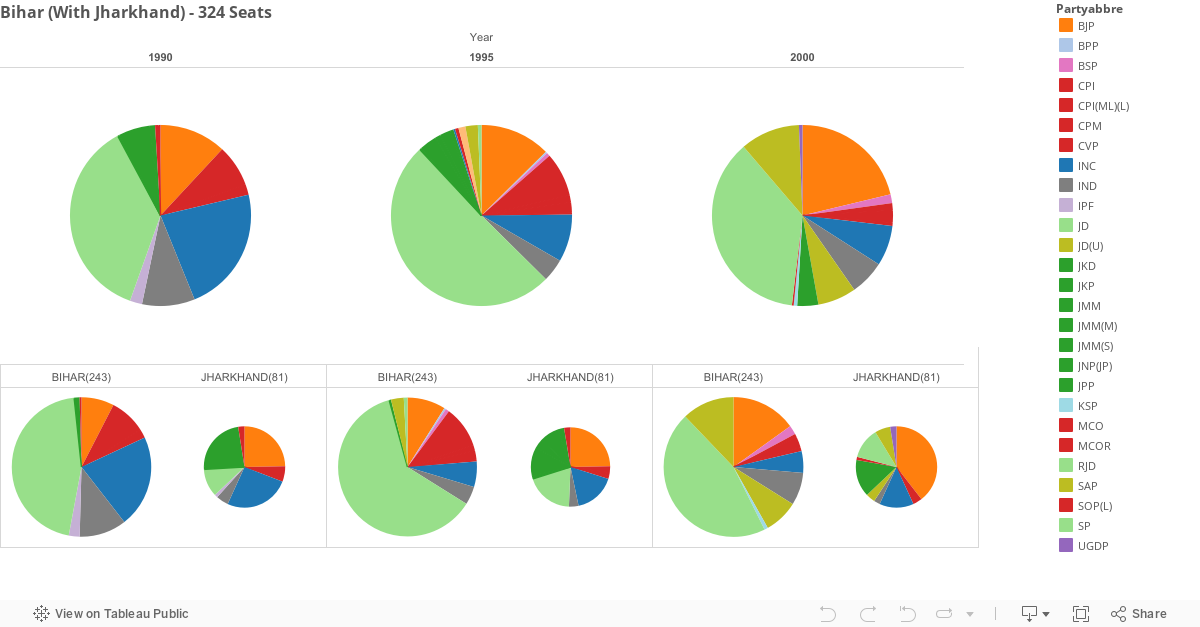
When Laloo Yadav first came to power in Bihar riding on the Mandal wave in 1990 to occupy the chair that his mentor Karpuri Thakur had once did with the support of the JMM among others. Even in the elections in 1995, his party dint do too well in southern Bihar but still came close to a clear majority based on a strong performance in the north. It was in this time that the Jharkhand Area Autonomous Committee (JAAC) under the chairmanship of Shibu Soren was formed in what some saw as a compromise formula and a step towards full statehood while others saw as a blatant sellout.
Almost all of Bihars mineral resources and a bulk of its heavy industries was concentrated in the southern part of the state. Given that Jharkhand if formed would take with it the lions share of the states revenues there was obviously a great deal of resistance in what would remain of Bihar to the idea of a new state.
In the assembly elections of 2000 Laloo Yadav made the bifurcation of the state a key issue and ultimately it was the the result of this election that that sealed the case for the creation of Jharkhand. The election threw up a hung assembly and meant that ruling over divided Bihar was Laloo Yadav's best case scenario. With a BJP government (which had long declared its support for a separate state) at the center the Bihar reorganization Act was finally passed in 2000 with the support of both the Congress and the RJD and the new state of Jharkhand was born. The graphic below shows the constitution of the first Jharkhand assembly.
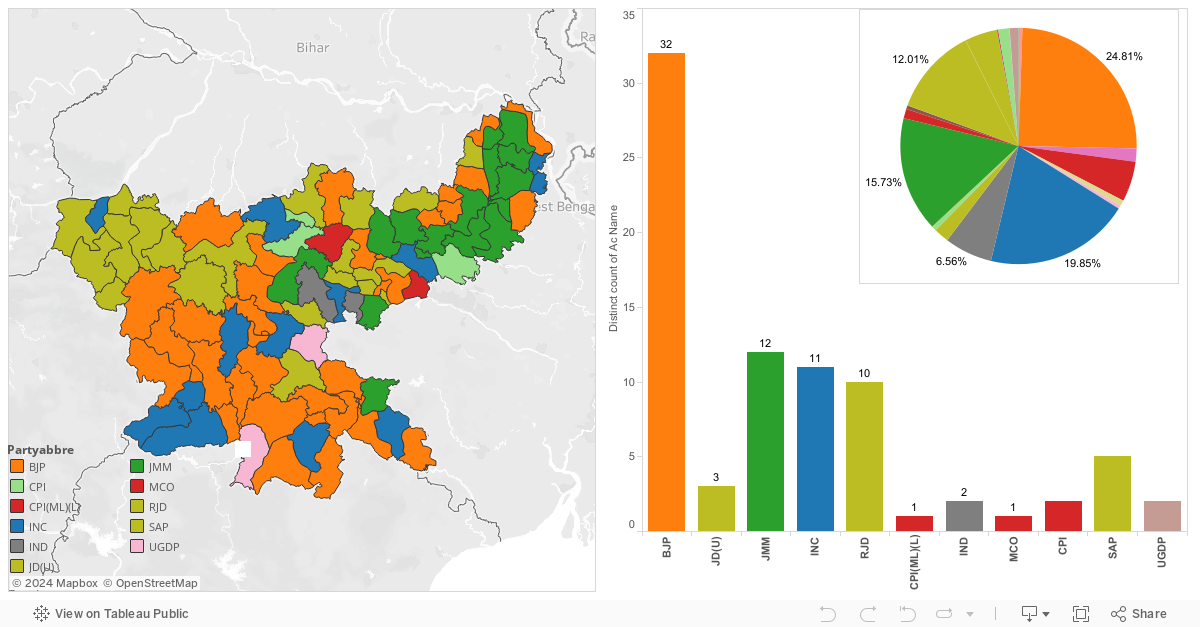
With 40 Seats and the support of independents the NDA formed the first government of Jharkhand under the leadership of Babulal Marandi. The new chief minister was widely acknowledged for is integrity, simple background as school teacher as well as the architect of various schemes to get the new state started. However one controversial move, with the Jharkhand Domicile Act, proved to be his undoing. Ostensibly created with the intent to strengthen the rights of tribals in their new homeland, the act that was perceived as against the rights of non-tribals in the state and was received with a lot of criticism and even some violence. Ultimately under pressure from alliance partners like the JD(U) Marandi was forced to quit in favor of Arjun Munda, barely 2.5 years into his term.
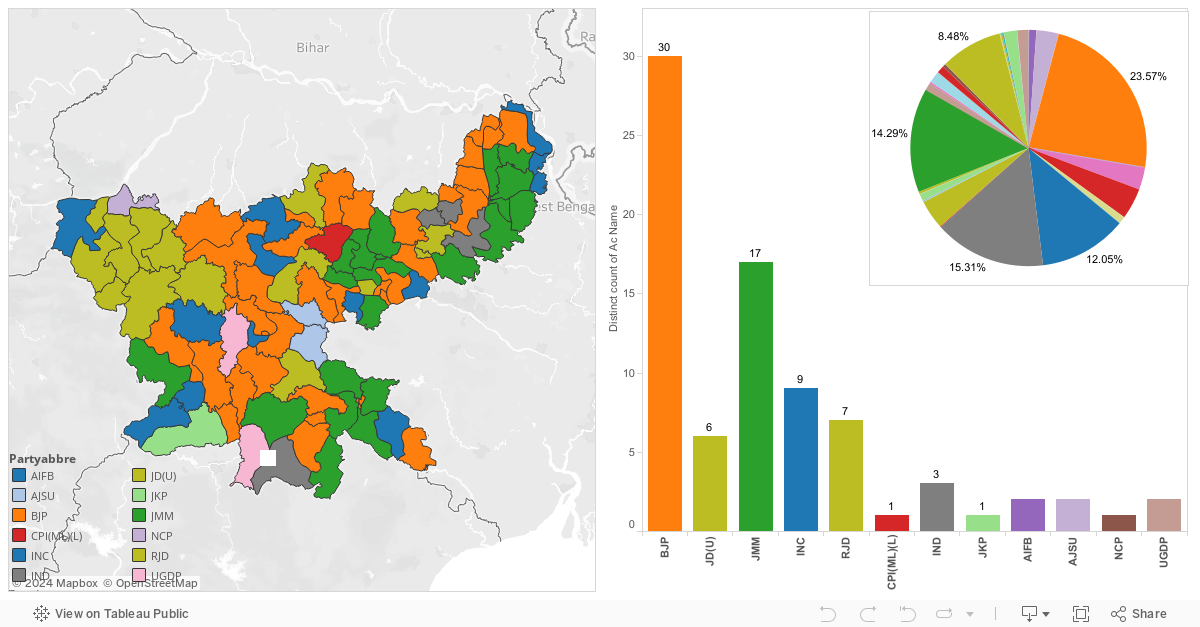
The graphic above shows the constitution of the second assembly of Jharkhand elected post the 2005 elections. The election threw up a hung assembly with the pre-election formations NDA(36) and UPA(33) running neck to neck. Shibu Soren(JMM) was invited by the governor - Syed Sibte Razi to form the government, inspite of the norm being to invite the leader of the largest pre-election formation. His government lasted a mere 10 days as he failed to garner the numbers and Arjun Munda (BJP/NDA) again became the CM with support from the block of 5 independent/other MLAs after protracted negotiations leading to plum ministerial posts for the independents. One of them Madhu Koda was appointed as Minister of Mining.
Arjun Munda's second stint was again not meant to last - after merely a year and a half the block of independents withdrew support leading to his resignation. A ramshackle (UPA) coallition was again formed and the block of 5 independents were able to extract their pound of flesh. Madhu Koda, an independent MLA became Jharkhands 4th chief minister leading a ministry with representatives from JMM, RJD, NCP, FB and 3 indipendent MLA's with outside support from the INC.
Barely 2 years into Madhu Koda's tenure, and after he had been asked to quit as union minister by Manmohan singh following a Dehi high court conviction, Shibu Soren made another desperate attempt for the post he had aspired for his entire life. The JMM withdrew support, Koda was forced to resign and relegated to the meaningless position of UPA while Shibu Soren became chief minister for the second time.
Guruji (as the elder Soren is called) finally got his chair but fate had other ideas. He lost the assembly by-election in the JMM stronghold of Tamar, and having failed to enter the assembly was forced to resign barely 144 days into his second stint. The state was thrown back into presidents rule and thus ended what could arguably be called the most farcical phase in the short history of the state or so it seemed at that time, but more was to follow.
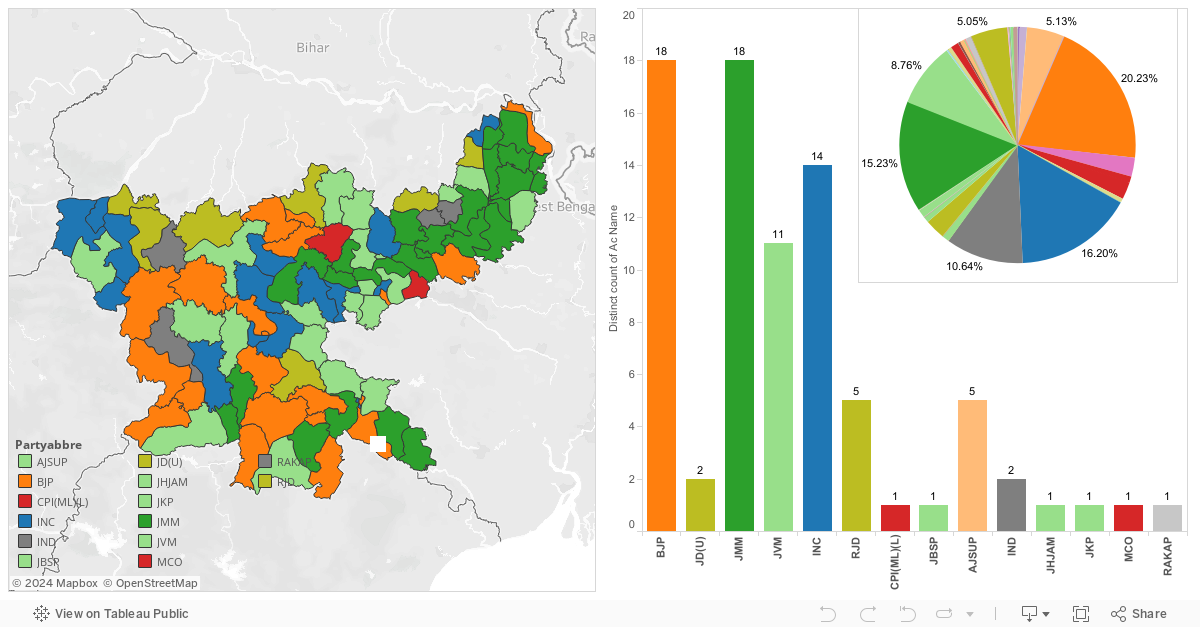
If 2005 had thrown up a divided mandate, 2009 took it one step further. The graphic above shows the constitution of the mandate of the 2009 assembly elections. While the polity of jharkhand was trundling between 2005 to 2009 elections, Babulal Marandi had managed to keep his distance from the state BJP and the series of crises. In the 2004 elections he fought the elections from Koderma and was the only BJP contestant (among 14) to win. In 2006 he finally bit the bullet, quit the BJP and formed his own party the Jharkhand Vikas Morcha (JVM). The Congress which was desperate to repair its image after the part that it (and its appointed governor) played in the previous assembly allied with 'the clean' Babulal Marandi's JVM. The result was a 3 way contest between the BJP-JD(U), JMM and the Congress-JVM, and another hung assembly
Again Shibu Soren made a play for power and this time the BJP came in to provide support before pulling out in 5 months, leading to another 3 month period of presidential rule. The BJP and JMM then agreed to (some) power sharing agreement with Arjun Munda becoming the chief minister and Hemant Soren as deputy CM. The details of what happened next are sketchy but by some accounts, the JMM wanted a rotation in chief ministership to which the BJP did not agree. As a result the JMM pulled the plug on the BJP government and finally after another period of Presidents rule Hemant Soren again became the chief minister of Jharkhand (now with Congress support) and remains to this day.
So that is the story of the this young state. It is the story of the lust for power reducing democracy in Jharkhand to being the theatre of the absurd and nearly every principal actor in the arena is guilty of playing their part. All this while Jharkhand has remained one of the most underdeveloped states in India. Twenty one of its twenty four districts still count among the most underdeveloped in the country. One cant miss the irony that Bihar whose 'clutches' the Jharkhand movement so dearly fought to escape has done much better in the last 10 years under the stable leadership of Nitish Kumar. Lastly the democratic process is supposed to offer hope (and a safety valve) to those living in the most wretched of conditions, but in Jharkhand its failure has only strengthened the appeal of alternatives like Naxalism. Today almost almost the entire state is considered Naxal effected and part of the so called 'Red corridor'.
Fourteen years ago Jharkhand embarked on a journey of statehood and it would be fair to say that if at all there is a 'failed state' in this country it is probably Jharkhand
The movement for a separate state of Jharkhand was injected with a fresh energy in the late 70's with the formation of the Jharkhand Mukti Morcha under the leadership of Shibu Soren and the All Jharkhand Students Union under the leadership of Surya Singh Besra. The 80's and 90's were also characterized by an element of radicalism in the Jharkhand movement, with innumerable 'bandhs' and economic blockades. Meanwhile the BJP the new entrant to the scene also threw its weight behind the creation of a separate state, Vananchal, as it preferred to call it.
Though the original demand had been of a 'greater Jharkhand' comprising of parts of West Bengal and Orissa, it is in Bihar that this movement created the maximum political impact. Through the 90's Laloo Yadav's JD/RJD kept doing well in the northern parts of the state, but not so well in the south where proponents of a separate state (the Jharkhand parties and the BJP) kept doing better. The elections to the Bihar Assembly between 1990 and 2000 kept throwing up fractured verdicts reflecting this chasm as can be seen in the figure below.
When Laloo Yadav first came to power in Bihar riding on the Mandal wave in 1990 to occupy the chair that his mentor Karpuri Thakur had once did with the support of the JMM among others. Even in the elections in 1995, his party dint do too well in southern Bihar but still came close to a clear majority based on a strong performance in the north. It was in this time that the Jharkhand Area Autonomous Committee (JAAC) under the chairmanship of Shibu Soren was formed in what some saw as a compromise formula and a step towards full statehood while others saw as a blatant sellout.
Almost all of Bihars mineral resources and a bulk of its heavy industries was concentrated in the southern part of the state. Given that Jharkhand if formed would take with it the lions share of the states revenues there was obviously a great deal of resistance in what would remain of Bihar to the idea of a new state.
In the assembly elections of 2000 Laloo Yadav made the bifurcation of the state a key issue and ultimately it was the the result of this election that that sealed the case for the creation of Jharkhand. The election threw up a hung assembly and meant that ruling over divided Bihar was Laloo Yadav's best case scenario. With a BJP government (which had long declared its support for a separate state) at the center the Bihar reorganization Act was finally passed in 2000 with the support of both the Congress and the RJD and the new state of Jharkhand was born. The graphic below shows the constitution of the first Jharkhand assembly.
With 40 Seats and the support of independents the NDA formed the first government of Jharkhand under the leadership of Babulal Marandi. The new chief minister was widely acknowledged for is integrity, simple background as school teacher as well as the architect of various schemes to get the new state started. However one controversial move, with the Jharkhand Domicile Act, proved to be his undoing. Ostensibly created with the intent to strengthen the rights of tribals in their new homeland, the act that was perceived as against the rights of non-tribals in the state and was received with a lot of criticism and even some violence. Ultimately under pressure from alliance partners like the JD(U) Marandi was forced to quit in favor of Arjun Munda, barely 2.5 years into his term.
The graphic above shows the constitution of the second assembly of Jharkhand elected post the 2005 elections. The election threw up a hung assembly with the pre-election formations NDA(36) and UPA(33) running neck to neck. Shibu Soren(JMM) was invited by the governor - Syed Sibte Razi to form the government, inspite of the norm being to invite the leader of the largest pre-election formation. His government lasted a mere 10 days as he failed to garner the numbers and Arjun Munda (BJP/NDA) again became the CM with support from the block of 5 independent/other MLAs after protracted negotiations leading to plum ministerial posts for the independents. One of them Madhu Koda was appointed as Minister of Mining.
Arjun Munda's second stint was again not meant to last - after merely a year and a half the block of independents withdrew support leading to his resignation. A ramshackle (UPA) coallition was again formed and the block of 5 independents were able to extract their pound of flesh. Madhu Koda, an independent MLA became Jharkhands 4th chief minister leading a ministry with representatives from JMM, RJD, NCP, FB and 3 indipendent MLA's with outside support from the INC.
Barely 2 years into Madhu Koda's tenure, and after he had been asked to quit as union minister by Manmohan singh following a Dehi high court conviction, Shibu Soren made another desperate attempt for the post he had aspired for his entire life. The JMM withdrew support, Koda was forced to resign and relegated to the meaningless position of UPA while Shibu Soren became chief minister for the second time.
Guruji (as the elder Soren is called) finally got his chair but fate had other ideas. He lost the assembly by-election in the JMM stronghold of Tamar, and having failed to enter the assembly was forced to resign barely 144 days into his second stint. The state was thrown back into presidents rule and thus ended what could arguably be called the most farcical phase in the short history of the state or so it seemed at that time, but more was to follow.
If 2005 had thrown up a divided mandate, 2009 took it one step further. The graphic above shows the constitution of the mandate of the 2009 assembly elections. While the polity of jharkhand was trundling between 2005 to 2009 elections, Babulal Marandi had managed to keep his distance from the state BJP and the series of crises. In the 2004 elections he fought the elections from Koderma and was the only BJP contestant (among 14) to win. In 2006 he finally bit the bullet, quit the BJP and formed his own party the Jharkhand Vikas Morcha (JVM). The Congress which was desperate to repair its image after the part that it (and its appointed governor) played in the previous assembly allied with 'the clean' Babulal Marandi's JVM. The result was a 3 way contest between the BJP-JD(U), JMM and the Congress-JVM, and another hung assembly
Again Shibu Soren made a play for power and this time the BJP came in to provide support before pulling out in 5 months, leading to another 3 month period of presidential rule. The BJP and JMM then agreed to (some) power sharing agreement with Arjun Munda becoming the chief minister and Hemant Soren as deputy CM. The details of what happened next are sketchy but by some accounts, the JMM wanted a rotation in chief ministership to which the BJP did not agree. As a result the JMM pulled the plug on the BJP government and finally after another period of Presidents rule Hemant Soren again became the chief minister of Jharkhand (now with Congress support) and remains to this day.
So that is the story of the this young state. It is the story of the lust for power reducing democracy in Jharkhand to being the theatre of the absurd and nearly every principal actor in the arena is guilty of playing their part. All this while Jharkhand has remained one of the most underdeveloped states in India. Twenty one of its twenty four districts still count among the most underdeveloped in the country. One cant miss the irony that Bihar whose 'clutches' the Jharkhand movement so dearly fought to escape has done much better in the last 10 years under the stable leadership of Nitish Kumar. Lastly the democratic process is supposed to offer hope (and a safety valve) to those living in the most wretched of conditions, but in Jharkhand its failure has only strengthened the appeal of alternatives like Naxalism. Today almost almost the entire state is considered Naxal effected and part of the so called 'Red corridor'.
Fourteen years ago Jharkhand embarked on a journey of statehood and it would be fair to say that if at all there is a 'failed state' in this country it is probably Jharkhand


