Polling was completed for all the assembly segments of Jharkhand yesterday. In all the state recorded a turnout of 66 % which is much better than the 57% turnout in the last assembly elections and even marginally better than the impressive 64 % turnout in the 2014 Lok Sabha Elections.
In this post the intention is to analyze in greater detail the results from elections in Jharkhand and to understand what implications it has in the context of this election. The term 'past elections' needs a further elaboration here. As detailed out in the last post - even though as a state, Jharkhand has had only 2 assembly elections (2005, 2009), its first Assembly was derived from the Bihar Assembly election of 2000. Similarly as detailed earlier, the movement for a separate state in Jharkhand is an old one and the regions of south Bihar, now constituting Jharkhand have long demonstrated an electoral proclivity slightly different from the rest of Bihar. Hence the decision to go further back and include the results from assembly elections in the constituencies that now compromise Jharkhand (but before 2000 were a part of Bihar) as far back as 1977 in the analysis. Lastly the most significant data we have is the data from the Lok Sabha election of 2014. The election commision of India provides detailed data at the Assembly constituency (and even the Polling booth) level in what is called the Form 20. This analysis also includes consolidated form 20 data from jharkhand from the 2014 elections. It may even be useful to start from here, given that it was only 6 months ago and even though national elections and state elections are different, it can tell us a few things about how Jharkhand 2014 is likely to turn out.
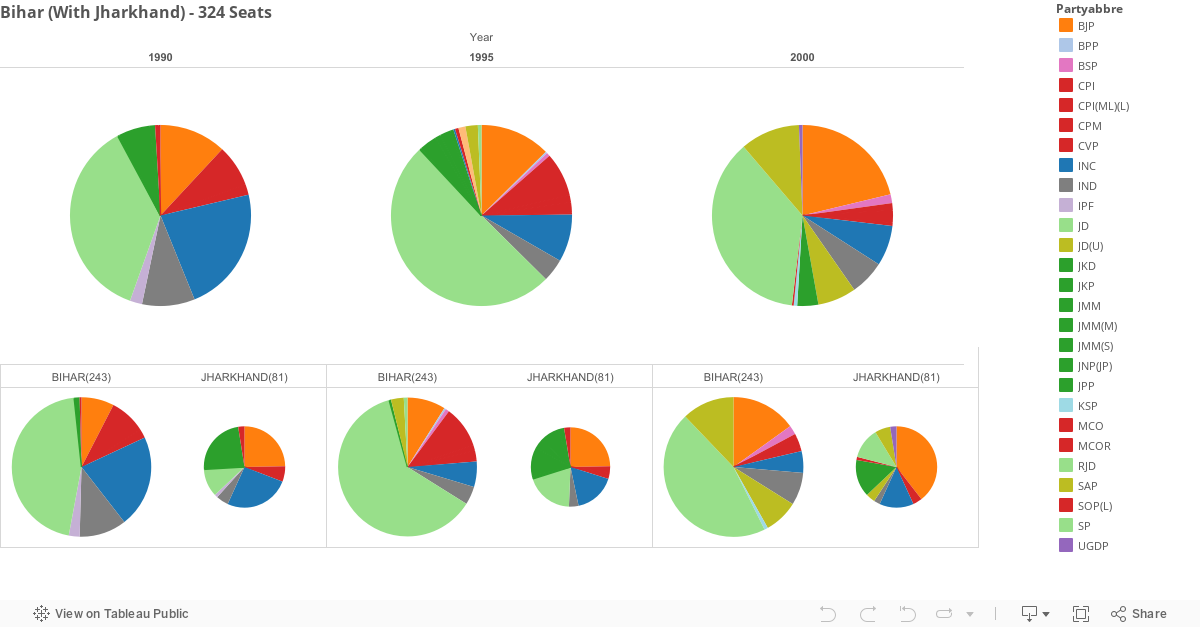
In this post I will start with analyzing data from Jharkhand elections over the last 4 decades to understand what it might imply for 2014. Also i will try take a more detailed look at the 2014 form 20 data, in the context of past elections, to come up with some hypotheses on what might happen in this assembly election. To start with lets take a look at a graphical representation of vote shares and seats won over the set of 9 elections that we picked as described in the previous paragraph.
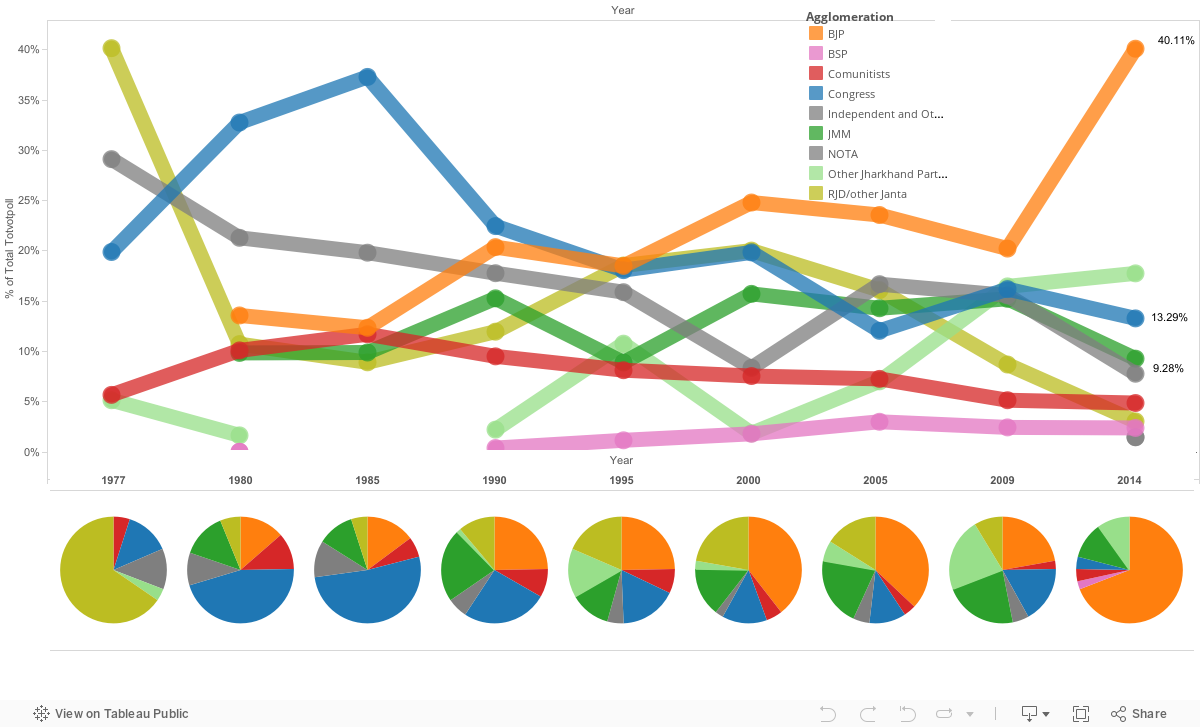
The first thing that gets evident about the politics of this state/region from this graphic is its highly fragmented nature. Throughout elections in the last two decades much of Jharkhand has witnessed a four cornered contest between the BJP, the Congress, the Janta parties and the Jharkhand parties. Also throughout this period the multi-cornered contests have led to bitterly divided mandates. The assembly elections of 2000 was the only time that one party or formation came decisively close to a clear majority. As we saw in the last post that was the verdict that ultimately led to the creation of Jharkhand and the formation of the first BJP government with the support of the JD(U).
In terms of the leadership position in this fragmented polity this has almost exclusively belonged to the BJP through the last 4 elections, both in terms of vote shares and seat won. Bihar in 1980 was one of the first election the BJP fought as a party and ever since then its support for statehood, tribal outreach (through the vanvasi kalyan kendras) and the divisive Ram temple aggitation has brought it to the forefront of the fragmented politics of Jharkhand, a position it has largely retained. Also worth noting is that the maximum the JMM has ever achieved in terms of vote share is around 17% and the maximum number of seats it has ever won is 18.
Also the Congress and the Janta parties are forces that is evidently on the wane in this region. The Congress did bounce back marginally in 2009 on the strength of its alliance with JVM but the fact that its vote share shrunk in 2014, in spite of contesting on 10 of the 14 seats in the alliance with the JMM, seems to confirm its steady slide. Given how it stands the prospects of the Congress-Janta alliance in this election would seem bleak but that is something we would get back to.
Thirdly, what becomes evident is the fragmented nature of 'Jharkhandi' politics itelf. Over the years even though the Jharkhand Mukti Morcha (JMM) has been the most prominent Jharkhand Regional party, there have been other Jharkhand regional parties like the All Jharkhand Students Union(AJSU) that have been around. The ones that have gained in strength most recently being the JVM (led by Marandi) and the JBSP (Madhu Kora's Party). An interesting factoid is that between the assembly elections of 2009 and the parliamentary elections of 2014, where the BJP made a decisive surge, the JVM was the only other party that registered an increase in vote share (despite the fact that it was a national election and the JVM a regional party)
Also worth mentioning is the lesser known fact that the extreme left still retains political influence in parts of Jharkhand. The CPI(ML)(L) has strongholds in Giridih, Kodarma where it routinely wins elections.
Lastly the Independents block, which has been significant block in Jharkhand, seems to be loosing traction, in what can only be seen as a welcome sign following the Koda years.
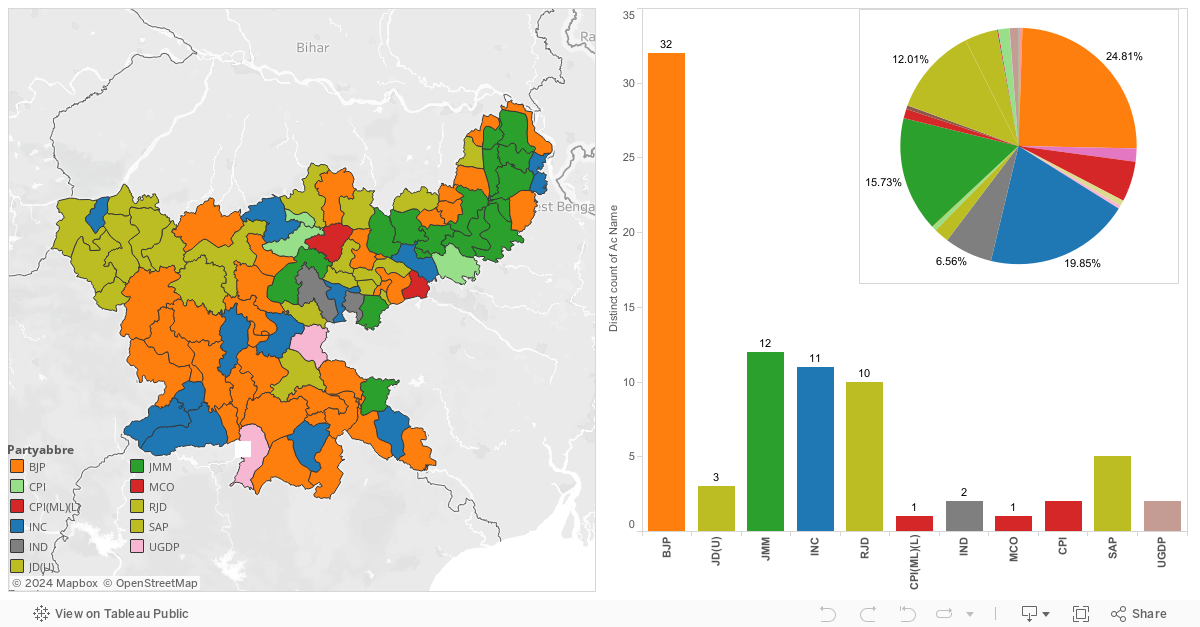
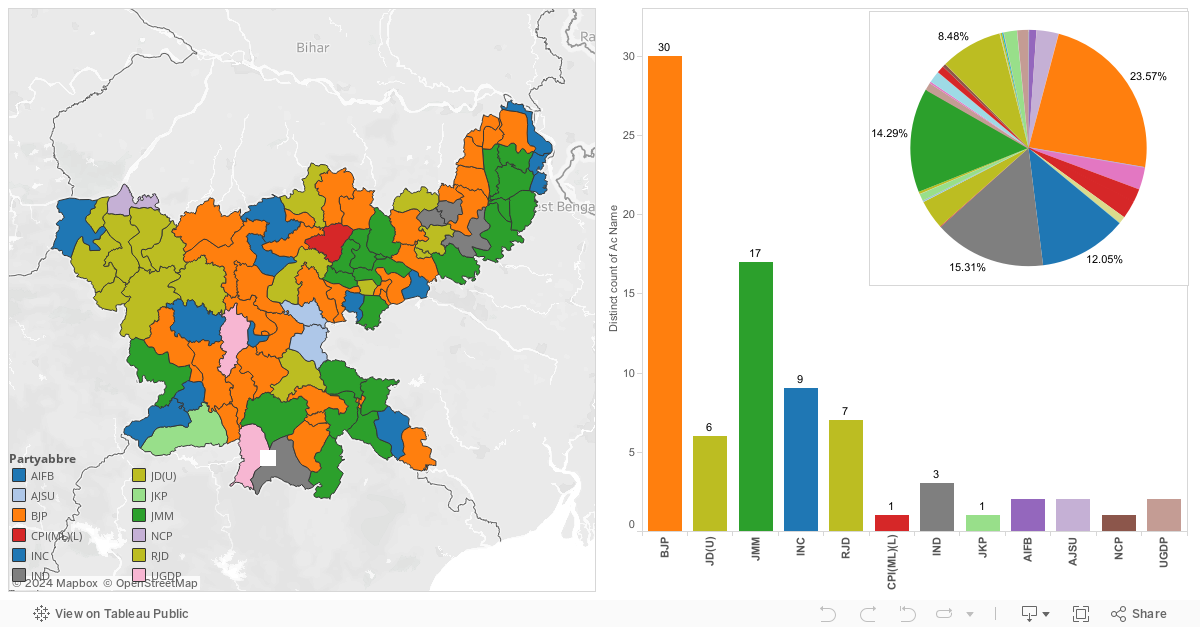
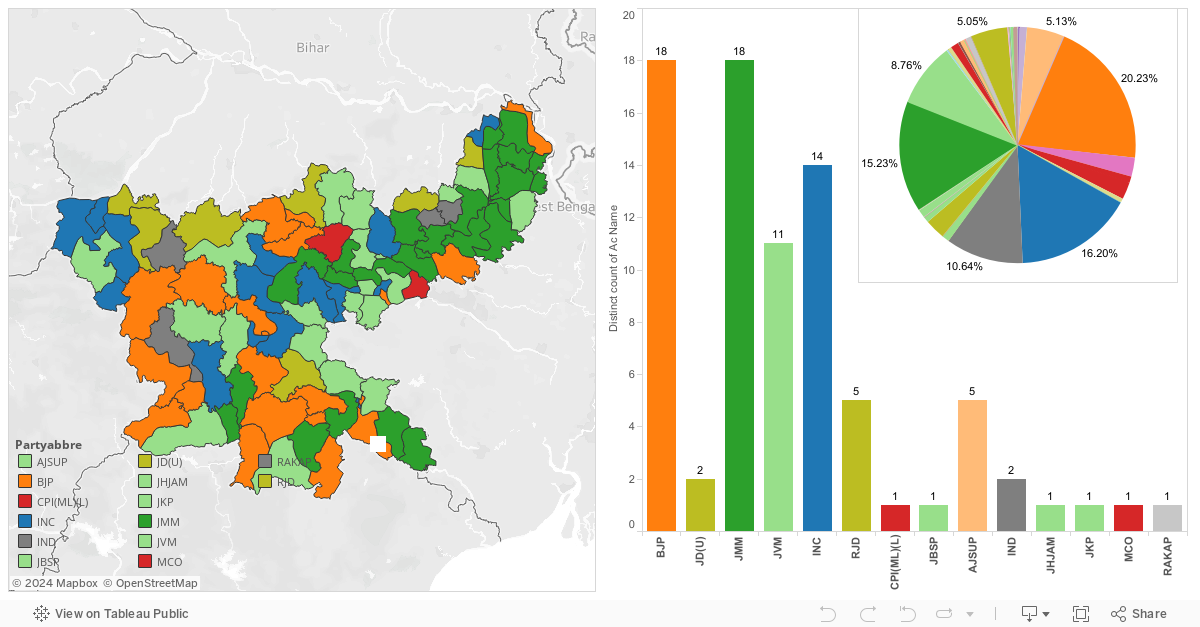
With that we move on to a map collage view of the 9 elections in our consideration set. just to give an idea of who has been winning where.
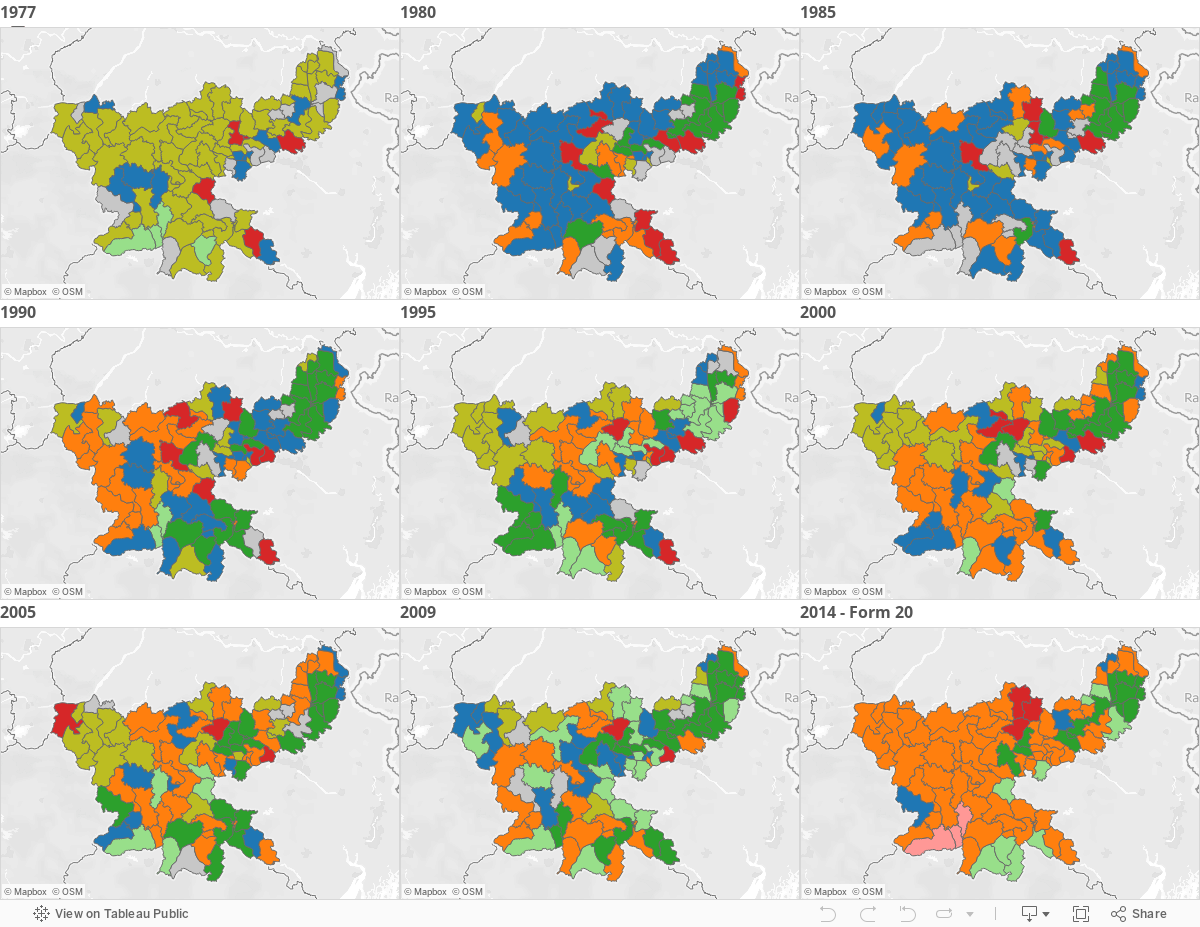
The areas of influence of various political formations become more evident from this graphic. As we can see the JMM has been routinely winning elections in the largely tribal north eastern areas of Santhal Parganas division and southern parts of Kolhan and Ranchi Divisions. On the other hand the influence of the Janta parties has been most pronounced in the regions bordering bihar i.e. the Palamau and Hazaribagh divisions. The Congress seems to be strongest in the Ranchi and the Palamau divisions but as we saw earlier its influence even there has been on the decline. The BJP seems to be the only party which has won in divisions across the state. This will become even more evident in the following graphic as we try to identify strongholds for various parties .i.e. based on the number of times in the last 6 elections that a party has won from a seat, the darker shade, the more the number of wins.
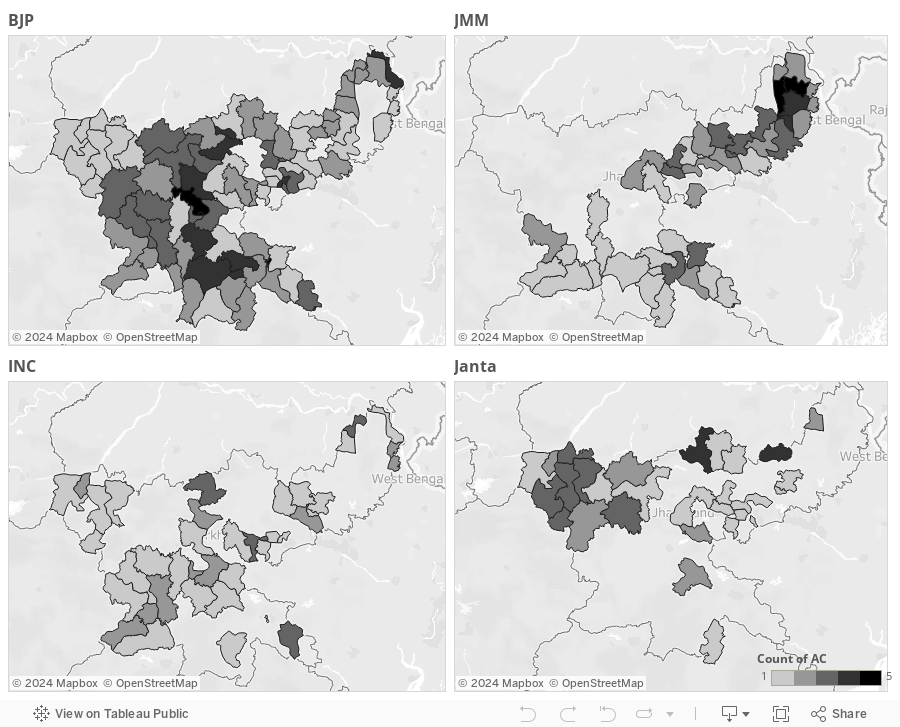
This again reaffirms, that the JMM is primarily strong in the tribal areas of Santhal Parganas, Chaibasa and Ranchi Divisions. It has never won a seat in the Palamau division and large parts of the Hazaribagh and Ranchi divisions. Similarly the Janta parties (JD, RJD, JD(U) et al, are primarily strong in the palamu division and the Hazaribagh division (bordering Bihar) and has practically won nothing in the rest of the state. The congress has been traditonally strong in the Ranchi division, which has produced leaders likeformer union minister Subodh Kant Sahai, but not much else where, and even there its influence seems to be on the wane. The BJP seems to be the only party to have won consistently across the state, with major urban strongholds like Jamshedpur, Kanke and Dhanbad where it has never lost in the last 5 elections.
We finally move on to take a deeper look at the results of the 2014 lok sabha elections and using this and the context of the previous elections extrapolate what may happen in the results tomorrow. The graphic below shows Jharkhand form 20 data from the 2014 Lok Sabha elections.
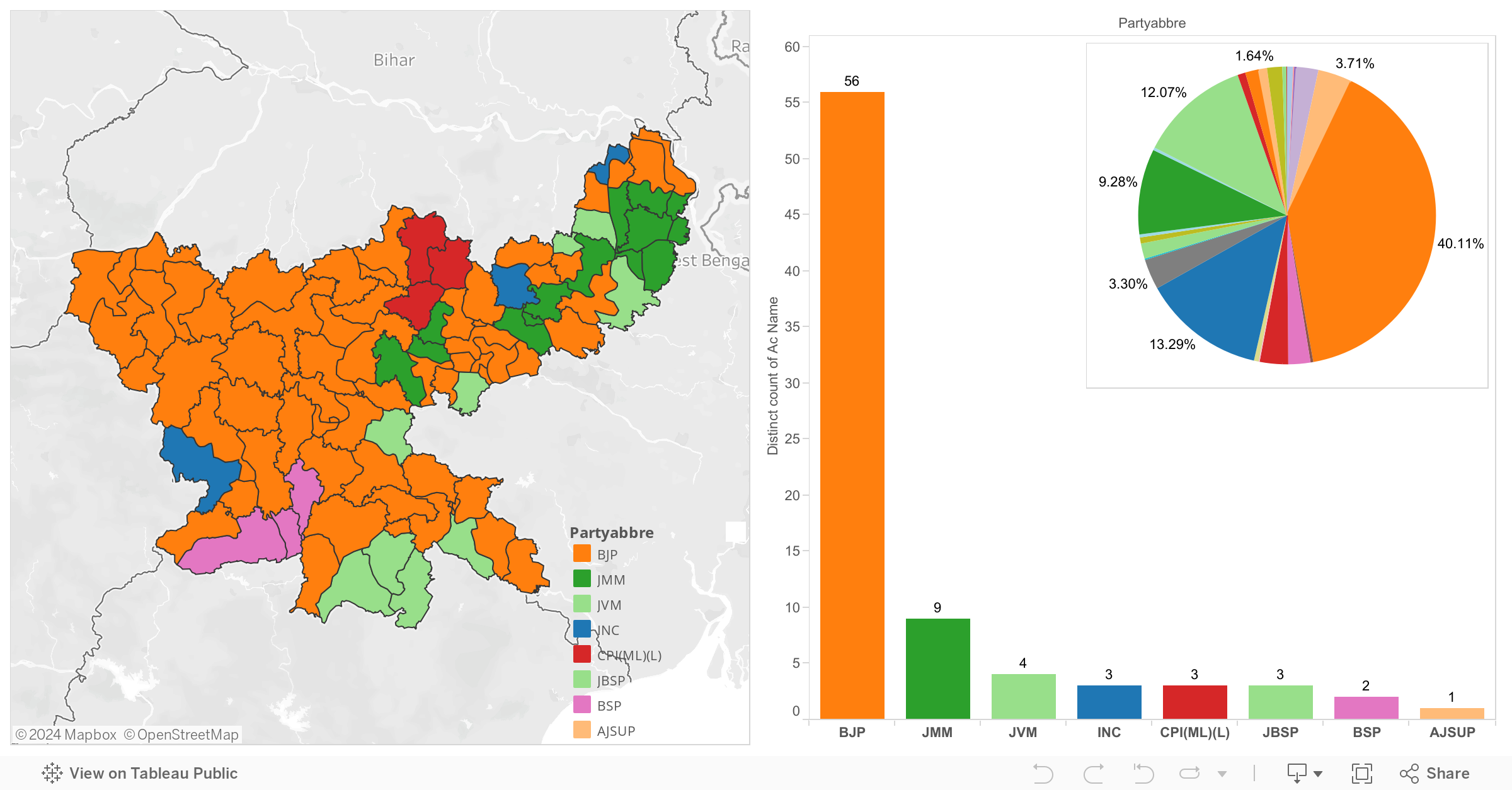
Like much of the northern part of the country the BJP literally swept Jharkhand - winning 12 of the 14 parliamentary constituencies. The remaining two being won by the JMM in its Santhal Pargana strongholds of Rajmahal and Dumka. In Jharkhand the BJP garnered a vote share of 40%, A good lead of 17% over the closest competing coalition (Congress +JMM) which together managed to garner barely 23%.Even looking at the Assembly constituency level from Form 20 data, the BJP did quiet impressively leading in 56 of the 81 Assembly constituencies. The JMM came next leading in 9 constituencies, but considering that it contested in only 4 of the 14 Lok Sabha Constituencies (i.e 22 of the 81 Vidhan sabha constituencies) its performance is not as bad as it looks. Much like the rest of India the Congress was routed in Jharkhand leading in only 3 out of the 51 constituencies it contested. There are a few surprises in the others box as well. If the BSP can repeat its performance in Khunti LS constituency where its candidate Subodh Purty gave a stiff challenge to BJP veteran Karia Munda in the Lok Sabha polls, there is a good chance that they would open their account in Jharkhand for the first time. Geeta Kora, wife of former chief minister Madhu Koda and JBSP contestant also performed credibly in Singhbhum leading in 3 assemblies. CPI(ML)(L) led in 3 segments of the Kodarma parliamentary constituency, long considered a left stronghold.
There have been some pronounced changes in the alliance arithmetic since May 2014. The Congress and JMM which fought the lok sabha elections together are no longer allies. The remaining constituents of the UPA - Congress and RJD have now been joined by the JD(U). Meanwhile BJP has secured the support of All Jharkhand Students Union(AJSU) and the JVM has allied with the Trinamul Congress (AITC).
Also the issues involved in a state election are very different from National elections. For starters while BJP had anti incumbency going for it 6 months ago, it may not be so in this election, the BJP having ruled (and many believe not very well) Jharkhand for close to 10 of its 14 years of existence. Secondly unlike the national election the state BJP does not have a strong leader as chief ministerial candidate. Lastly the Modi wave itself cannot sustain forever and has to wane.
However no other party/combination seems to be well positioned to significantly counter the BJP. As we saw earlier the JMM has limitations in terms of geographical reach. In reality calling it an pan Jharkhand party could be a stretch. The Congress+RJD+JD(U) grand alliance showed its promise in the Bihar by elections, and could have been a force to reckon with, at least in the areas bordering Bihar, primarily in the Palamau and Hazaribagh divisions, but it is in the execution that this alliance has failed. In close to 10 constituencies, these parties are fighting against one another, and not surprisingly most of these 10 are in the two aforementioned divisions where they would have stood a chance had they fought together. Lastly the JVM shows promise and could be the wildcard. Marandi is still recognized as an honest leader and even in the 2014 wave election, the JVM still managed to increase its vote share, vis-a-vis 2009, when it was fighting in alliance with the Congress. The problem is that given the size of their base even a 5% jump in vote share does not make a significant dent.
Finally, given the magnitude of the BJP's performance six months ago, and given they won almost 2/3 of the assembly constituencies against a united opposition of Congress+JMM (now fighting separately) this election is the BJP's to lose and the looking at the 2014 Lok Sabha result they should canter home to at least a simple majority. In that context the BJP's 'Mission 42' is really somewhat of an oxymoron (aren't missions meant to be aspirational, and why would someone aspire for a simple majority, when they are just coming out of an election where they won 2/3). If anything it highlights the diffidence of the BJP state leadership. Indeed the BJP getting any less than 45 seats in this election (though very unlikely) would be a damning verdict against them.
In this post the intention is to analyze in greater detail the results from elections in Jharkhand and to understand what implications it has in the context of this election. The term 'past elections' needs a further elaboration here. As detailed out in the last post - even though as a state, Jharkhand has had only 2 assembly elections (2005, 2009), its first Assembly was derived from the Bihar Assembly election of 2000. Similarly as detailed earlier, the movement for a separate state in Jharkhand is an old one and the regions of south Bihar, now constituting Jharkhand have long demonstrated an electoral proclivity slightly different from the rest of Bihar. Hence the decision to go further back and include the results from assembly elections in the constituencies that now compromise Jharkhand (but before 2000 were a part of Bihar) as far back as 1977 in the analysis. Lastly the most significant data we have is the data from the Lok Sabha election of 2014. The election commision of India provides detailed data at the Assembly constituency (and even the Polling booth) level in what is called the Form 20. This analysis also includes consolidated form 20 data from jharkhand from the 2014 elections. It may even be useful to start from here, given that it was only 6 months ago and even though national elections and state elections are different, it can tell us a few things about how Jharkhand 2014 is likely to turn out.
In this post I will start with analyzing data from Jharkhand elections over the last 4 decades to understand what it might imply for 2014. Also i will try take a more detailed look at the 2014 form 20 data, in the context of past elections, to come up with some hypotheses on what might happen in this assembly election. To start with lets take a look at a graphical representation of vote shares and seats won over the set of 9 elections that we picked as described in the previous paragraph.
The first thing that gets evident about the politics of this state/region from this graphic is its highly fragmented nature. Throughout elections in the last two decades much of Jharkhand has witnessed a four cornered contest between the BJP, the Congress, the Janta parties and the Jharkhand parties. Also throughout this period the multi-cornered contests have led to bitterly divided mandates. The assembly elections of 2000 was the only time that one party or formation came decisively close to a clear majority. As we saw in the last post that was the verdict that ultimately led to the creation of Jharkhand and the formation of the first BJP government with the support of the JD(U).
In terms of the leadership position in this fragmented polity this has almost exclusively belonged to the BJP through the last 4 elections, both in terms of vote shares and seat won. Bihar in 1980 was one of the first election the BJP fought as a party and ever since then its support for statehood, tribal outreach (through the vanvasi kalyan kendras) and the divisive Ram temple aggitation has brought it to the forefront of the fragmented politics of Jharkhand, a position it has largely retained. Also worth noting is that the maximum the JMM has ever achieved in terms of vote share is around 17% and the maximum number of seats it has ever won is 18.
Also the Congress and the Janta parties are forces that is evidently on the wane in this region. The Congress did bounce back marginally in 2009 on the strength of its alliance with JVM but the fact that its vote share shrunk in 2014, in spite of contesting on 10 of the 14 seats in the alliance with the JMM, seems to confirm its steady slide. Given how it stands the prospects of the Congress-Janta alliance in this election would seem bleak but that is something we would get back to.
Thirdly, what becomes evident is the fragmented nature of 'Jharkhandi' politics itelf. Over the years even though the Jharkhand Mukti Morcha (JMM) has been the most prominent Jharkhand Regional party, there have been other Jharkhand regional parties like the All Jharkhand Students Union(AJSU) that have been around. The ones that have gained in strength most recently being the JVM (led by Marandi) and the JBSP (Madhu Kora's Party). An interesting factoid is that between the assembly elections of 2009 and the parliamentary elections of 2014, where the BJP made a decisive surge, the JVM was the only other party that registered an increase in vote share (despite the fact that it was a national election and the JVM a regional party)
Also worth mentioning is the lesser known fact that the extreme left still retains political influence in parts of Jharkhand. The CPI(ML)(L) has strongholds in Giridih, Kodarma where it routinely wins elections.
Lastly the Independents block, which has been significant block in Jharkhand, seems to be loosing traction, in what can only be seen as a welcome sign following the Koda years.
With that we move on to a map collage view of the 9 elections in our consideration set. just to give an idea of who has been winning where.
The areas of influence of various political formations become more evident from this graphic. As we can see the JMM has been routinely winning elections in the largely tribal north eastern areas of Santhal Parganas division and southern parts of Kolhan and Ranchi Divisions. On the other hand the influence of the Janta parties has been most pronounced in the regions bordering bihar i.e. the Palamau and Hazaribagh divisions. The Congress seems to be strongest in the Ranchi and the Palamau divisions but as we saw earlier its influence even there has been on the decline. The BJP seems to be the only party which has won in divisions across the state. This will become even more evident in the following graphic as we try to identify strongholds for various parties .i.e. based on the number of times in the last 6 elections that a party has won from a seat, the darker shade, the more the number of wins.
This again reaffirms, that the JMM is primarily strong in the tribal areas of Santhal Parganas, Chaibasa and Ranchi Divisions. It has never won a seat in the Palamau division and large parts of the Hazaribagh and Ranchi divisions. Similarly the Janta parties (JD, RJD, JD(U) et al, are primarily strong in the palamu division and the Hazaribagh division (bordering Bihar) and has practically won nothing in the rest of the state. The congress has been traditonally strong in the Ranchi division, which has produced leaders likeformer union minister Subodh Kant Sahai, but not much else where, and even there its influence seems to be on the wane. The BJP seems to be the only party to have won consistently across the state, with major urban strongholds like Jamshedpur, Kanke and Dhanbad where it has never lost in the last 5 elections.
We finally move on to take a deeper look at the results of the 2014 lok sabha elections and using this and the context of the previous elections extrapolate what may happen in the results tomorrow. The graphic below shows Jharkhand form 20 data from the 2014 Lok Sabha elections.
Like much of the northern part of the country the BJP literally swept Jharkhand - winning 12 of the 14 parliamentary constituencies. The remaining two being won by the JMM in its Santhal Pargana strongholds of Rajmahal and Dumka. In Jharkhand the BJP garnered a vote share of 40%, A good lead of 17% over the closest competing coalition (Congress +JMM) which together managed to garner barely 23%.Even looking at the Assembly constituency level from Form 20 data, the BJP did quiet impressively leading in 56 of the 81 Assembly constituencies. The JMM came next leading in 9 constituencies, but considering that it contested in only 4 of the 14 Lok Sabha Constituencies (i.e 22 of the 81 Vidhan sabha constituencies) its performance is not as bad as it looks. Much like the rest of India the Congress was routed in Jharkhand leading in only 3 out of the 51 constituencies it contested. There are a few surprises in the others box as well. If the BSP can repeat its performance in Khunti LS constituency where its candidate Subodh Purty gave a stiff challenge to BJP veteran Karia Munda in the Lok Sabha polls, there is a good chance that they would open their account in Jharkhand for the first time. Geeta Kora, wife of former chief minister Madhu Koda and JBSP contestant also performed credibly in Singhbhum leading in 3 assemblies. CPI(ML)(L) led in 3 segments of the Kodarma parliamentary constituency, long considered a left stronghold.
There have been some pronounced changes in the alliance arithmetic since May 2014. The Congress and JMM which fought the lok sabha elections together are no longer allies. The remaining constituents of the UPA - Congress and RJD have now been joined by the JD(U). Meanwhile BJP has secured the support of All Jharkhand Students Union(AJSU) and the JVM has allied with the Trinamul Congress (AITC).
Also the issues involved in a state election are very different from National elections. For starters while BJP had anti incumbency going for it 6 months ago, it may not be so in this election, the BJP having ruled (and many believe not very well) Jharkhand for close to 10 of its 14 years of existence. Secondly unlike the national election the state BJP does not have a strong leader as chief ministerial candidate. Lastly the Modi wave itself cannot sustain forever and has to wane.
However no other party/combination seems to be well positioned to significantly counter the BJP. As we saw earlier the JMM has limitations in terms of geographical reach. In reality calling it an pan Jharkhand party could be a stretch. The Congress+RJD+JD(U) grand alliance showed its promise in the Bihar by elections, and could have been a force to reckon with, at least in the areas bordering Bihar, primarily in the Palamau and Hazaribagh divisions, but it is in the execution that this alliance has failed. In close to 10 constituencies, these parties are fighting against one another, and not surprisingly most of these 10 are in the two aforementioned divisions where they would have stood a chance had they fought together. Lastly the JVM shows promise and could be the wildcard. Marandi is still recognized as an honest leader and even in the 2014 wave election, the JVM still managed to increase its vote share, vis-a-vis 2009, when it was fighting in alliance with the Congress. The problem is that given the size of their base even a 5% jump in vote share does not make a significant dent.
Finally, given the magnitude of the BJP's performance six months ago, and given they won almost 2/3 of the assembly constituencies against a united opposition of Congress+JMM (now fighting separately) this election is the BJP's to lose and the looking at the 2014 Lok Sabha result they should canter home to at least a simple majority. In that context the BJP's 'Mission 42' is really somewhat of an oxymoron (aren't missions meant to be aspirational, and why would someone aspire for a simple majority, when they are just coming out of an election where they won 2/3). If anything it highlights the diffidence of the BJP state leadership. Indeed the BJP getting any less than 45 seats in this election (though very unlikely) would be a damning verdict against them.